
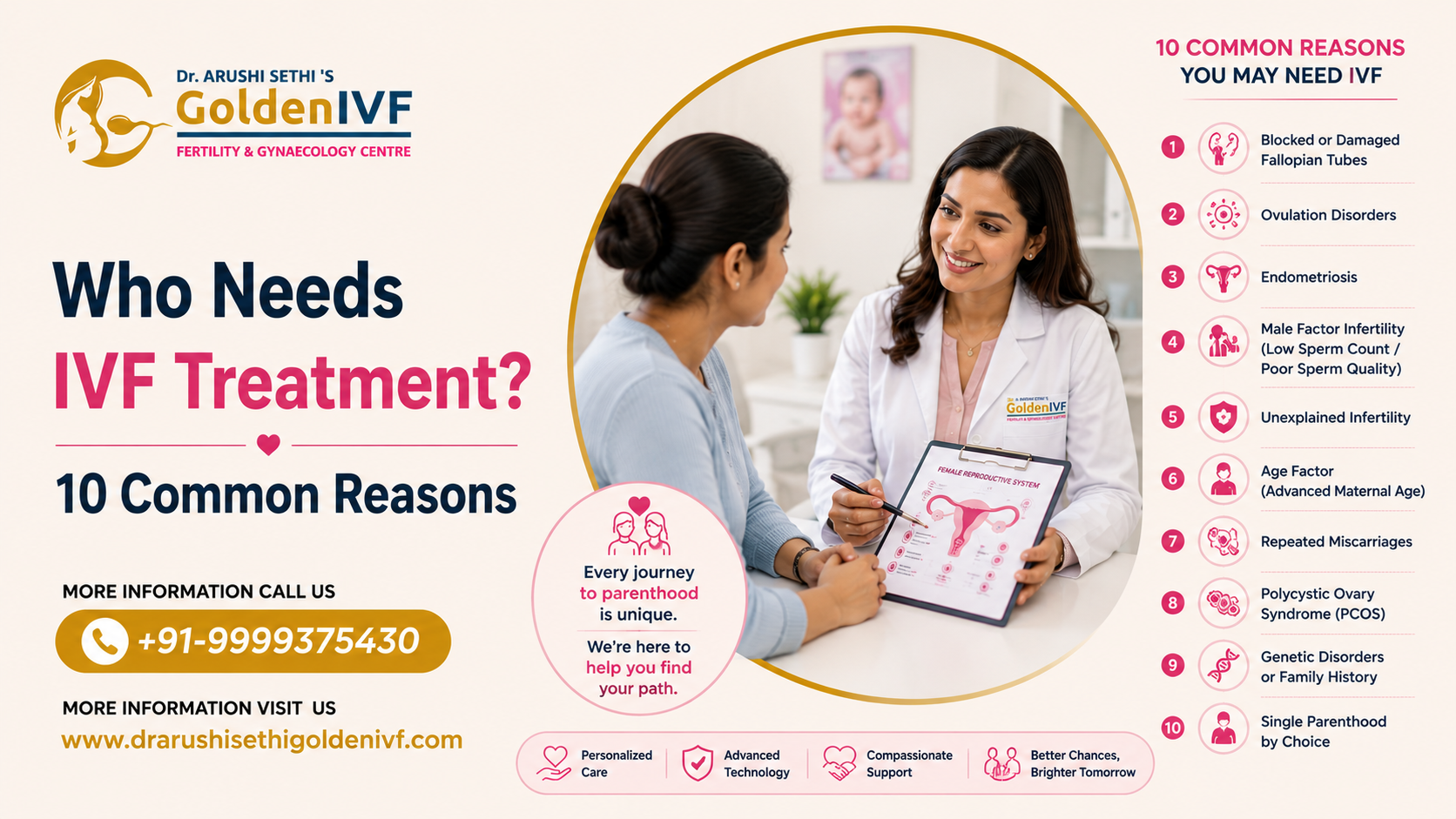
Not getting any results despite repeated attempts to conceive can be exhausting. A few couples conceive with lifestyle changes, medications or treatments such as IUI. Whereas others might require more advanced treatments. So who actually needs IVF treatment in Rohini?
In vitro fertilisation (IVF) is usually recommended when specific fertility factors are making natural conception hard, or when other treatments haven’t worked. However, it doesn’t mean IVF treatment is the right choice for everyone. Before recommending a plan, a fertility specialist considers several factors such as age , ovarian reserve, sperm health, fallopian tube condition, medical history, and any previous treatments.
At Dr. Arushi Sethi – Golden IVF, treatment plans are customised after accessing all the factors before a course of treatment is set.
When Is IVF Recommended
IVF is not the first treatment a fertility specialist suggests. Most patients try less invasive options such as IUI before assisted reproductive technology is required. IVF is generally suggested when a specific fertility issue makes conception difficult, when other treatments haven’t worked, or when the chances of conception could improve with assisted reproductive technology.
Here are the common reasons a fertility specialist might recommend it and if any of the terms sound familiar, you are suggested to book a consultation without any delay.
1.Blocked or Damaged Fallopian Tubes
Who Needs IVF Treatment? 10 Common Reasons The fallopian tubes are the pathway for the egg and sperm to meet. If they’re blocked or damaged, fertilisation may not happen naturally.
In such a case IVF treatment can help. In IVF treatment, fertilisation is done outside the body in a laboratory and the embryo forms, it’s transferred into the uterus.
2.Low Sperm Count or Poor Sperm Quality
Infertility is not only a female-related issue. Male-related issues such as low sperm count, poor motility, or abnormalities in sperm can cause difficulty in conceiving.
Depending on the couple’s own circumstances, IVF might be suggested. In some cases, doctors pair it with ICSI (Intracytoplasmic Sperm Injection) to help fertilisation.
3. Ovulation Problems
Conception depends on regular ovulation. Conditions such as PCOS or PCOD or other hormonal imbalances can interfere with the release of eggs and getting pregnant naturally becomes harder.
But not every woman with irregular ovulation needs IVF. Many women with irregular ovulation respond well to medication or other fertility treatments first. If these methods are unsuccessful, IVF treatment may be an option.
4. Endometriosis
Endometriosis can affect reproductive health, making it harder to achieve pregnancy. But it doesn’t affect every patient the same way.
For endometriosis-related infertility, doctors look at the full fertility profile before recommending IVF. Golden IVF treats endometriosis as part of its fertility services, so both issues can be managed alongside.
5. Age-Related Fertility Decline
Fertility naturally changes as women get older. That mostly affects two things, egg quantity and egg quality.
Getting older doesn’t mean IVF is the next step. But for some people, especially when additional fertility issues are there, a specialist may recommend straight to IVF rather than trying less advanced treatment first.
6. Unexplained Infertility
Sometimes fertility evaluations don’t identify an obvious reason for why conception isn’t happening. Doctors refer to this as unexplained infertility.
Whether a specialist recommends moving from less advanced treatments to IVF depends on age, how long the couple has been trying and what’s already been tried (in terms of treatment).
7. Previous IUI Treatments Have Not Worked
IUI is often the first option tried before IVF in appropriate cases. In IUI treatment, the prepared sperm is placed directly into the uterus during the time of ovulation.
When several IUI cycles don’t lead to a successful pregnancy, a fertility specialist may reassess and consider whether IVF treatment is the appropriate next step. This decision depends on the outcomes of previous treatments.
8. Previous IVF Failure
One unsuccessful IVF cycle doesn’t mean future treatment won’t work. After a failed cycle, the fertility specialist may review each stage and the specific circumstances of the previous cycle.
A second opinion can also help patients to understand whether the treatment approach needs to change.
9. Reduced Ovarian Reserve
Reduced ovarian reserve means fewer remaining eggs available for fertilization. Age is the most common reason, but it isn’t the only one, other factors can lower reserves too.
When ovarian reserve is reduced, a fertility specialist may discuss IVF treatment as an option after accessing the person’s age, test results, reproductive goals, and overall fertility profile. IVF allows the ovaries to be stimulated so multiple eggs can be retrieved in a single cycle.
10. When Other Fertility Factors Require Advanced Treatment
Sometimes, infertility isn’t always caused by one clear problem, it’s a combination of factors.
One couple might be dealing with reduced ovarian reserve and male-factor infertility at the same time. Another might have tubal problems layered on top of age-related decline. In cases like these, a fertility specialist may recommend IVF Centre In Rohni as it can tackle multiple barriers within one treatment path.
Is IVF the Only Treatment for Infertility
Not necessarily. IVF treatment is one of the more advanced options in fertility care, but it’s not recommended to every couple initially. Many people do better with ovulation medication, lifestyle changes, timed intercourse, IUI, or treatment for an underlying condition before considering IVF.
The right approach depends on the cause of infertility and the couple’s individual circumstances and that’s why a fertility specialist may evaluate:
- Age and reproductive history
- Menstrual and ovulation patterns
- Ovarian reserve
- Hormone levels
- Semen analysis
- Fallopian tube health
- Uterine health
- Previous fertility treatments
- Relevant medical conditions
When Is the Right Time to See a Fertility Specialist
If you’ve been trying to conceive without success, it may be useful to seek guidance from a fertility specialist rather than assuming IVF is either necessary or not.
A consultation helps you identify the difficulties and determine whether you need treatment at all, and if you do, which option is most appropriate.
Still, needing IVF isn’t a failure and choosing IVF should not be based on someone else’s experience. Fertility treatment should be built around your medical needs and circumstances.
Take the Next Step With Personalised Fertility Care
IVF treatment isn’t a decision based on a general checklist, it is supposed to be based on your fertility profile. Knowing the possible reasons for IVF recommendation can help you have a more informed conversation with a fertility specialist.
Dr. Arushi Sethi – Golden IVF offers a vast number of treatments including IVF, IUI, and ICSI, treatment for male and female infertility, PCOS/PCOD, and endometriosis. If you are still not sure if IVF is the right path for you, a consultation can help you understand your options clearly, so you can decide on next steps with expert guidance.