
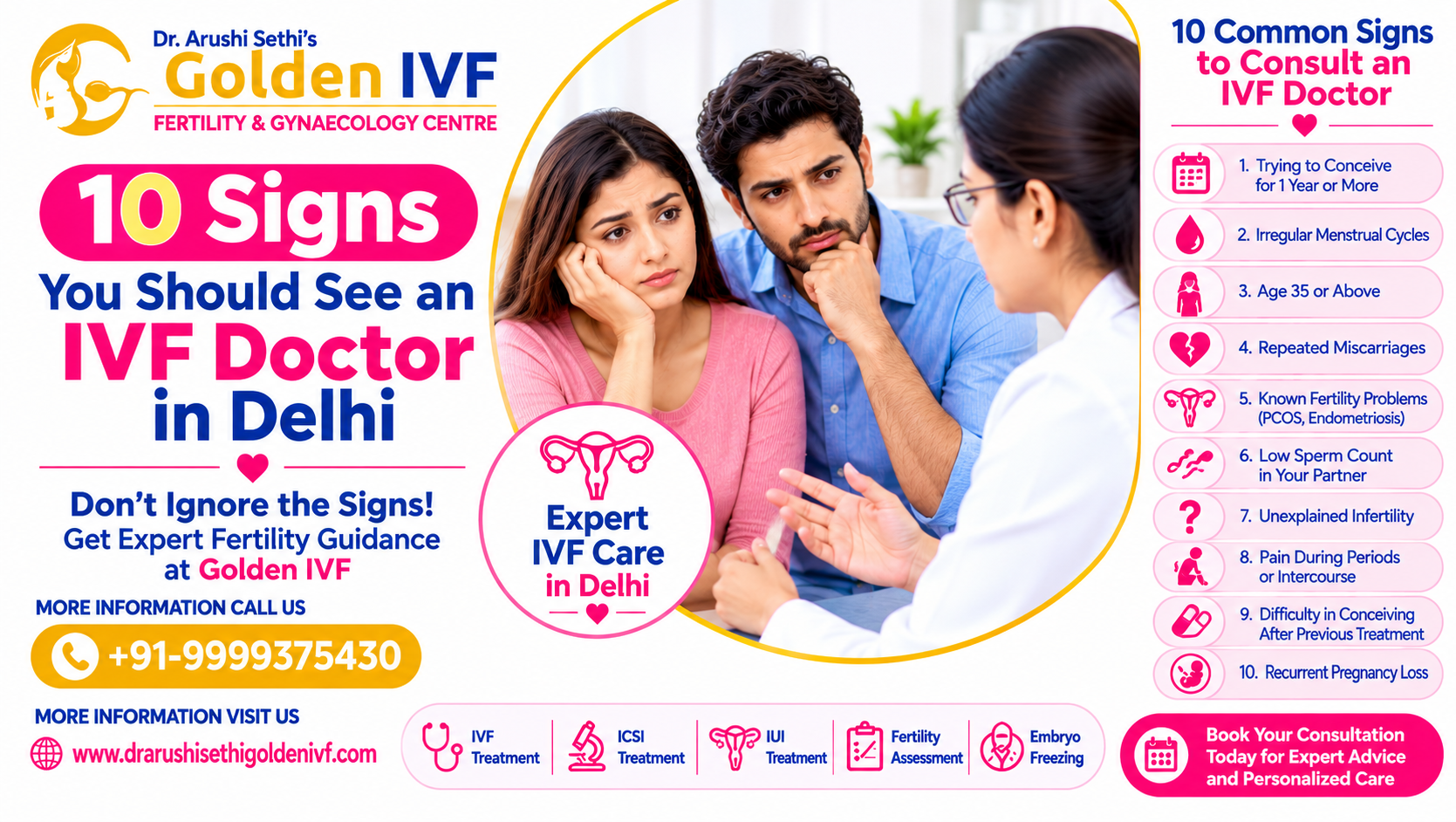
There are certain couples who have taken the decision to see a fertility specialist after they have been trying for months without success. On the other hand, some couples see their doctor because they have irregular periods, have lost a pregnancy or face some other reproductive health problem. These issues prompt couples to wonder if they need to get medical advice. The best way to know when to consult the Best IVF Doctor in Delhi is to understand what could be impacting your fertility and what treatments are possible.
At Dr. Arushi Sethi’s Golden IVF, we advise couples to not wait to seek advice when they find it difficult to get pregnant. An early fertility evaluation will help in the diagnosis of any underlying issues, understand chances of natural conception and also help understand if ovulation induction, IUI or IVF are the right treatment plans for you.
Here are 10 signs which indicate you should meet a fertility specialist
1. Failing to Get Pregnant Despite Regular Attempts
If you are having difficulties getting pregnant despite having regular unprotected intercourse then this is perhaps the most obvious reason to see an IVF doctor. As a general rule, a fertility evaluation should be sought after 12 months of trying if the woman is under 35 years of age. For women in the age range of 35-39 years, it is recommended to seek help after 6 months. Women who are in their 40s and above would do well to get an evaluation right away.
These are not hard and fast rules. If you have other fertility concerns then there is no harm in seeking advice. In fact, this is perhaps the best way to see an IVF Specialist in Delhi to understand your overall fertility health and if any investigation/treatment is required.
2. Irregular Periods Are Impeding Conception
A woman’s menstrual cycle provides good insight into her reproductive health. Irregular periods, periods which are late or occur unpredictably or even the absence of periods for a few months could indicate an irregular or absent ovulation.
Conditions like PMOS, thyroid problems, hormonal imbalances can disturb the ovulation process. This makes it difficult to calculate the fertility window when ovulation is occurring on time. Come meet us and we can help you figure out why these changes are occurring. It could be a medication to help you ovulate, some lifestyle changes or perhaps a hormonal evaluation.
3. You have been diagnosed with PMOS or Endometriosis
Gynaecological conditions like these can affect your fertility even if you are experiencing a relatively normal menstrual cycle. Endometriosis can cause adhesions in the pelvis and inflammation that alters the environment for reproduction. PMOS can affect the ovulation process.
This does not mean you will necessarily need IVF. Many women are able to conceive with a suitable approach or medical management. At Golden IVF, we do not stop at diagnosing you but want to understand how a particular condition is affecting your case so that we can advise treatment based on the individual and not simply the diagnosis.
4. You have had Miscarriages in the Past
Miscarrying more than once can be emotionally taxing. A single miscarriage is not a sign of infertility, but two or more miscarriages should be evaluated.
There could be many factors that contribute including uterine or chromosomal abnormalities, or even hormonal or some other medical condition. Our team will discuss your history with you and recommend tests that can help identify any treatable factors. This is in order to plan your care before you attempt to conceive again.
5. Male Fertility Problems from your Partner
It is not always the female partner who has fertility problems. The reproductive health of the male partner is also important for conception.
Male fertility can be affected by hormonal problems, certain medical conditions or even previous infections or surgeries. A semen analysis is often one of the first recommendations, and this could lead to IUI, IVF or ICSI. An IVF Expert in Delhi can make sure that both partners understand the options, and the focus is not always on the woman.
6. Blocked Fallopian Tubes
For natural conception healthy fallopian tubes are a must since that is where fertilisation occurs. A blockage or damage to one or both of the tubes can prevent the sperm and egg meeting successfully. Such tubal damage may be due to a history of pelvic infections, ectopic pregnancies, endometriosis or surgery in the abdominal or pelvic region.
A HSG and other investigations are useful for evaluating the health of the tubes. If they are found to be damaged or blocked, IVF is an option since it allows fertilisation to occur outside the body before the embryo being placed in the uterus.
7. Age is a factor
For female fertility, age matters. The number and quality of eggs decline with time. This is more pronounced after 35 and tends to pick up pace in the late thirties and early forties. Those who wish to postpone pregnancy seeking fertility advice at an early stage will be beneficial to understand their ovarian reserve and options available.
While AMH, antral follicle count and hormone tests can be informative, the results have to be read in context with age and medical history. A word with the Best IVF Doctor in Delhi will allow for informed decisions to be made without delay.
8. Prior treatments have been unfruitful
Ovulation induction and several IUI cycles may be undertaken by a couple with no success, as can happen with IVF. When a treatment fails to deliver, it is important to understand why. The doctor may have to re-evaluate the records, the condition of the uterus, the sperm and how the ovaries and embryos have responded, instead of just going through the procedure again.
At Golden IVF, we take unsuccessful attempts as a cue to lead a close evaluation with the medical information on hand. We may then suggest a revised plan that could involve different medication, more tests or another procedure altogether.
9. A diagnosis of low ovarian reserve
The term refers to the number of eggs remaining in the ovaries. With a lower reserve the ovaries might not give a strong response to fertility medications. Although low ovarian reserve doesn’t mean that a natural conception is out of the question, it does influence how one plans for treatment and the time frame available for reproductive choices.
Before talking about egg freezing or IVF, our team will want to weigh in on your age, past response to treatment and what you hope to achieve, in addition to considering AMH and antral follicle figures to assess ovarian reserve.
10. No clear answers despite trying
Not every fertility problem comes with obvious symptoms. Some couples have regular periods and nothing shows up on the first round of reports but still cannot get pregnant; this is known as unexplained infertility. It doesn’t mean there is nothing wrong or treatment options are limited. More in depth evaluation can turn up what was missed before. With an experienced fertility team, we can help you understand the reports and advise if it is normal to keep trying naturally or move on to IUI or IVF.
Better Medical Guidance For Your Next Step
Spotting these signs is an important step but when to ask for help is a matter of your particular medical and reproductive background. An IVF consultation is not a commitment to have the treatment done. It is a chance to clear your concerns and get clarity on your fertility.
At Dr. Arushi Sethi’s Golden IVF, we figure out the root cause of any difficulty with conception before we recommend a plan of treatment. We build our approach to suit the individual by taking into account the hormonal health and uterine condition of both partners to the sperm parameters and prior investigations.
Dr. Arushi Sethi has over 10 years of experience in providing personalised care and will work closely with you to set realistic expectations and give clear direction, be it for an initial assessment or following a failed treatment.
There is no need to let every worry develop before getting professional input. A timely consultation with the right specialist can put things in perspective and make the next steps clearer.