
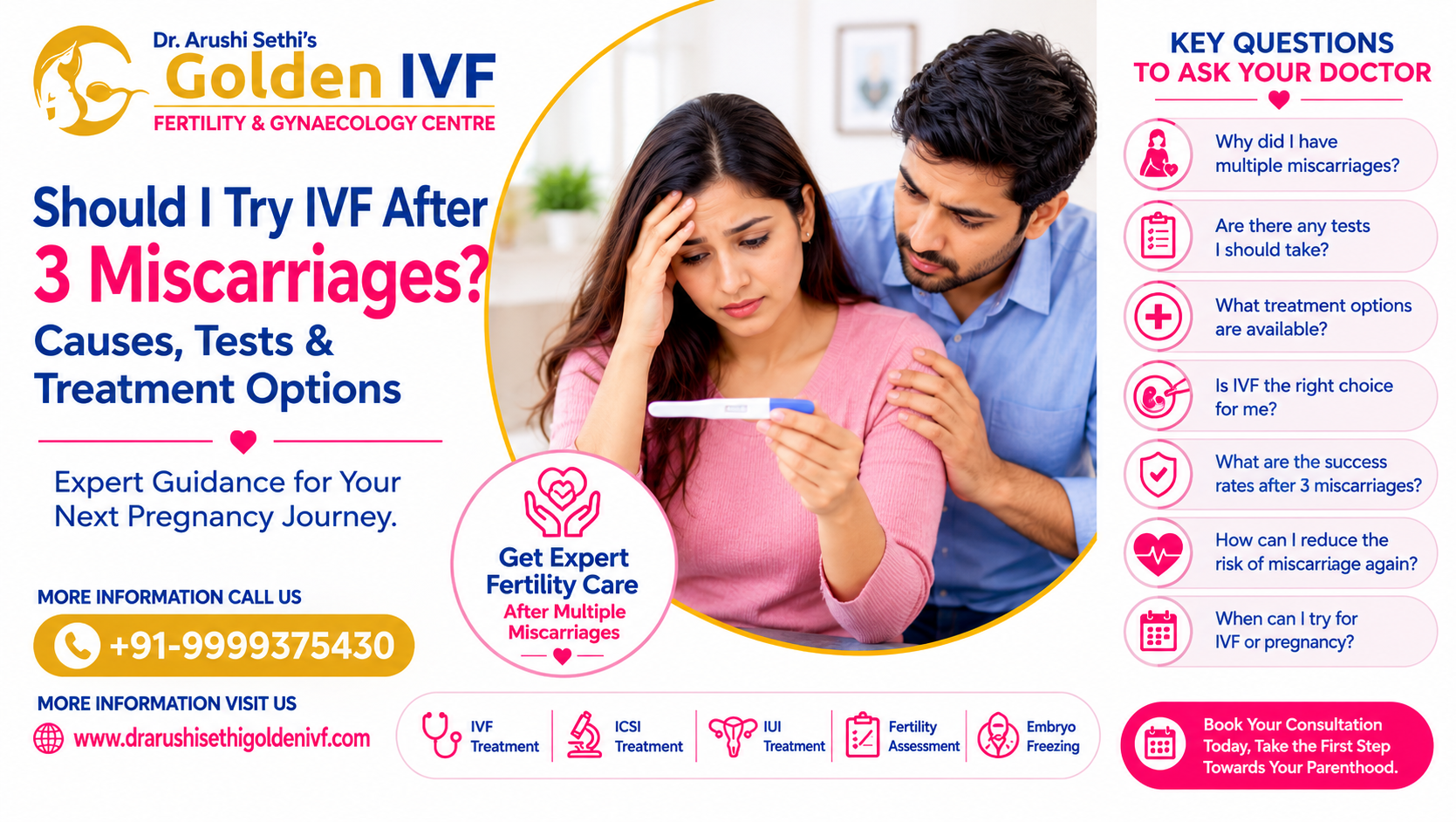
While 1 miscarriage is difficult enough to go through emotionally, 3 consecutive miscarriages can make a couple question if they can ever have a successful pregnancy or not. Apart from the sadness and uncertainty of going through a miscarriage, a couple also feels concerned if there is a cause which could affect the development of the embryo, or its ability to implant, or even to carry a pregnancy to term.
If a couple has been through 3 miscarriages, it is time that they consult a fertility specialist and discuss the possible cause of the problem. While IVF after 3 miscarriages can be the right treatment option under certain conditions, it is not the automatic treatment choice for all couples. The treatment choice is based on various factors including medical history, age, a proper fertility assessment, and also on what the underlying cause of the problem may be.
At Golden IVF, we believe that a couple that has gone through multiple miscarriages should go through a detailed and compassionate evaluation, and come up with a treatment plan that is specific to their situation. It is not enough to be just concerned about the conception aspect, we also need to know what could be interfering with a successful outcome.
Three Miscarriages? Requires a Medical Review
While more than 2 miscarriages are considered recurrent pregnancy loss, in some clinical guidelines, it is 3 consecutive miscarriages that are considered the threshold. The problem is that even if a couple has multiple miscarriages, the causes could be different in each case, and this is why a thorough assessment is needed.
Some couples get pregnant naturally but have a miscarriage early in pregnancy, while others may have difficulty getting pregnant at all, and have a history of miscarriage. The situations are different, and need to be dealt with differently.
Possible Causes for Recurrent Miscarriage
Not all recurrent miscarriages are caused by the same thing. Understanding the causes for recurrent miscarriage enables us to see if IVF or medication, or genetic testing or other intervention is needed in the treatment process. Some of the causes for recurrent miscarriages are:
Chromosomal abnormalities: Chromosomal errors in the embryos themselves occur randomly and often lead to an early miscarriage. The risk of this increases as the mother gets older.
Uterine problems: Fibroids distorting the cavity, a septum, adhesions etc. may prevent implantation.
Hormonal and metabolic disorders: Uncontrolled thyroid disorders and diabetes can pose risks. PCOS is another condition which needs evaluation.
Blood clotting disorders and immune factors: Antiphospholipid syndrome is one condition which causes recurrent miscarriages and is treatable. Other immune causes for recurrent miscarriage need to be assessed clinically rather than just assumed.
Parental genetic disorders: Sometimes one of the parents may have a balanced chromosomal rearrangement which will lead to a higher risk of chromosomal errors in the embryos.
Unexplained loss: Sometimes no cause can be found. This does not mean that one cannot be treated or have a successful pregnancy.
By identifying the most likely cause of recurrent miscarriages, we can avoid superfluous treatments and perform only those that have a medical basis for being done.
Necessary Tests Prior to Recommending IVF Treatment
It is important that a couple with recurrent miscarriages undergo a complete evaluation of their fertility prior to being advised to have IVF. Based on the clinical history, our doctors will recommend the necessary tests.
1. Genetic and chromosomal evaluation
Sometimes a karyotype of both parents will be recommended to rule out chromosomal rearrangements. Testing of pregnancy tissue (if available) from a previous miscarriage can sometimes help to find a cause for the loss.
2. Uterine cavity assessment
Sometimes we may advise a hysteroscopy or a saline infusion sonography to rule out any problems with the uterine cavity which may affect pregnancy. A routine pelvic ultrasound or 3D ultrasound may also be advised.
3. Hormonal and metabolic evaluation
This may include testing for thyroid function, glucose levels and other parameters based on symptoms and history.
4. Evaluation for Antiphospholipid Syndrome
This is important to test for, by means of blood tests which check for the presence of related antibodies, as it is associated with recurrent miscarriages and may need specific treatment.
5. Complete fertility evaluation
Evaluation of ovarian reserve, ovulation and semen quality are some of the important parameters that we assess to decide if natural conception or IUI or IVF is to be recommended.
Not all the tests are needed for every patient. It is better to do tests based on clinical indications rather than order a large panel of unnecessary tests.
Is IVF the Right Next Step After Three Miscarriages?
In some cases, IVF can be of benefit, especially where there are identifiable genetic or fertility issues at play with the repeated miscarriages. But it is not a concrete way to prevent miscarriage; even an embryo that looks good for transfer can fail to implant and lead to a loss of the pregnancy. We will recommend IVF as an option in cases such as:
- Where a couple has a known fertility problem in addition to recurrent miscarriages.
- If a parental chromosomal rearrangement makes genetic counselling and testing of the embryo relevant.
- To produce embryos for more in depth genetic evaluation.
- When advanced maternal age or a low ovarian reserve necessitates a measured approach to fertility.
- Should prior investigations suggest that assisted reproduction is the more appropriate path to conception.
For those who have conceived naturally but suffer unexplained recurrent pregnancy loss, IVF is unlikely to make much difference to the chances of a good outcome. Supportive management and treatment directed at the cause would be more suitable.
IVF Treatment After Miscarriage: Available Options
If our investigations point toward assisted reproduction we will choose a course of treatment as per the couple’s situation and needs.
Conventional IVF
Following ovarian stimulation the eggs are retrieved and fertilised with sperm in the lab. We then monitor the embryos until one is appropriate for transfer.
ICSI
With intracytoplasmic sperm injection a single sperm is inserted directly into the egg. We may recommend this in the case of male-factor infertility or other fertilisation matters.
IVF with PGT-SR
Where a parent has a structural chromosomal rearrangement, preimplantation genetic testing (PGT-SR) may help identify embryos without the corresponding unbalanced chromosomal changes.
IVF with PGT-A
This form of testing examines embryos for chromosome-number abnormalities. While we may discuss it in certain circumstances, it cannot be relied upon to prevent miscarriage or boost live birth rates across the board.
Frozen Embryo Transfer
If embryos are available, a frozen embryo transfer allows
the uterine lining to be prepared before a transfer in a later cycle. It is a good alternative when a fresh transfer is not clinically advisable.
Preparing Body and Mind for Another Pregnancy
Deciding on an IVF procedure simply doesn’t end with a yes, let’s do it. Addressing any health issues prior to conception can make an important decision in pregnancy care.
A check of thyroid function, blood sugar and nutritional status as well as any medical conditions is recommended. We also advise folic acid before conception at a dose commensurate with the individual’s risk profile. A diagnosis of antiphospholipid syndrome would require specialist treatment with heparin and low-dose aspirin, which should not be taken without medical direction.
Let’s not forget the emotional side. The prospect of scans, appointments and testing can be anxiety provoking after repeated miscarriages. Our counselling and a supportive consultation can give a couple the confidence to move forward.
A More Informed Path Forward with Golden IVF
At Golden IVF, we understand after three miscarriages, another pregnancy is a source of hope as well as apprehension. We start by hearing your history of previous pregnancies and looking over the investigations to understand what may have been behind each loss.
We as a team along with Dr. Arushi Sethi will focus on identifying the right treatment for you and not proffer IVF, just because it is a well-known treatment. Your findings may call for medical management, further investigations, genetic counselling or an assisted reproductive technique.
There is no one treatment to ensure success. Yet with an appropriate plan, you can be better informed about your reproductive health and the future. If you have had three miscarriages, get in touch with us and the Golden IVF team is ready to go over your medical history and compile together a plan of action for your situation.